Showing posts with label Echo360. Show all posts

Saturday, May 17, 2008

Basex Awards Echo360 System Architecture

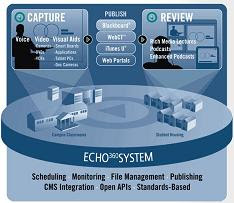
Echo360 System ArchitectureAccording to a report in Earthtimes, Echo360 has been named a "Visionary Vendor" in education technology by Basex, a leading knowledge economy research and advisory firm.

Basex praised the new architecture of Echo360 System, hailing its "centralized hub to schedule, manage and monitor lecture capture operations, as well as a first-of-its-kind dedicated hardware appliance to capture content inside the classrooms".

I agree that thin clients and dedicated capture appliances are the best option for capture, and that a centralised content management and scheduling system will increasingly provide added value to presentation recording. However this design is not reflected in current pricing. Echo360 charges only for capture, using per-station licenses, and charges nothing for the content management and scheduling.

Also, as I pointed out in my recent review of the Echo360 System v2.1, the capture stations are unable to stand on their own or provide immediate playback of confidence recordings. The appliances are tethered to the server, and the software-only installations have been dumbed-down. This is an unacceptable compromise for those interested in either mobile capture stations or a phased rollout of recording capability, followed by later deployment of the server infrastructure.

Sure, one can purchase just a single classroom license, but to actually use that capture station, you've got to deploy the whole backend suite first. So while the architecture is being praised by Basex as a "significant advancement in classroom technology", I think the design makes Echo360 an all-or-nothing proposition.

Sunday, May 4, 2008

First Look at Echo360 Version 2.1

I finally had an opportunity to view Echo360 version 2.1, and it is clearly a very different product than Anystream's Apreso 1.3.x.

Gone is the distributed encoding architecture. The content manager is substantially improved, and it is designed to record via networked 'capture appliances'. The capture appliances produce H.264 video, which is then transcoded at the server before it can be viewed. The video is trascoded to Quicktime and the display graphics is transcoded to Flash Video (ie- FLV format). The H.264 is retained for editing. Audio MP3, eBook M4B and 'vodcast' (that's audio plus full motion presentation graphics) in M4V format are also output during transcoding.

The content manager is bundled with the Jetty (J2EE) web application server and the Derby database. It also comes with a Java-based Wowza Media Server (though you may use a licensed Flash Media Server if you prefer).

This new release is heavily server-centric, which could be fine for big institutions. But what about for a smaller campus or corporate use? My first impression is that it's going to be difficult to sell this product to any but the largest institutions.

As long as we're on first impressions, I've got to say that the new release has many plus points, including better integration of scheduling and content management (with scheduling now done at the server), better user and course administration (with more granular control of admin rights) and support for publishing to multiple LMS or CMS applications (you can actually publish the same recording into multiple courses). The user interface is certainly nicer, and works well in Mozilla browsers. The installation is easier, and licenses now require activation (which prevents piracy).

But I have some concerns about limitations of this release as well:


  • standalone capture software is not supported (unless installed via the server)
  • software-based capture does not support video recording (it can record audio and display graphics only)
  • raw files are not viewable before transcoding (again limiting software-based capture)


These issues will be a barrier to customers who wish to trial the capture station software, or who don't need a server at the initial deployment phase. Although the server software is free, there are significant 'hidden' costs that will be incurred when deploying the server software, SSL certs, a media server and the media processors. Not to mention the need to buy capture station hardware to record video. These issues may even prevent 1.3.x customers from migrating to the new platform - they will be giving up the flexibility and recording capability they enjoy now.

However I understand that current customers may opt for phased migration. They can upgrade the server first, and still use 1.3.x capture stations. They can then add hardware appliance capture stations or wait for a release of the software only version which includes video support.

Also, there are some minor annoyances in this release:


  • additional Win2003 server hardware and licenses are required for each 5 capture stations
    (one of the key architectural benefits of the 1.3.x release was decentralised processing)
  • product installation obscures the location of important files such as the database
  • for each hour of content, approximately 30 minutes of transcoding is required after uploading
  • software activation requires an Internet connection (not available in some settings)
  • confidence in AV connections is not addressed; users must still make test recordings
  • no support for Vista on the standalone capture software (XP Pro is end-of-life)
  • no support for 3rd-party LMS and CMS software (currently Blackboard, WebCT and Moodle are supported)
  • no support for mic inputs on the hardware-based capture station (ok, very minor)


Sadly, this release does not include viewer usage reports and presentation editing.

I think at the very least, Echo360 would need to provide for: (a) standalone capture station installation, (b) offline software activation just like Microsoft and Adobe, and (c) some utility which will convert recordings to a viewable format on the capture station. Without these capabilities, there can be no trial installations, no simple or small-enterprise deployments that don't include a server and no confidence-building display of test recordings. The need to connect to a server just to complete a test recording also means unnecessary complexity for laptop sales demos.

I also feel that intentionally crippling the capture station software to prevent video recording is a show-stopper. So Echo360 should provide: (d) a video license upgrade option for standalone capture stations.

Thursday, November 8, 2007

Thoughts on Creighton Case Study

Just got off the live webcast from Echo360 Inc, hosted by GM Mark Jones and Creighton University's Tracy Chapman. Tracy provided an excellent case study of how her institution started with MP3 podcasting, graduated to Apreso presentation recording, and is now scaling up to 5 classrooms.

Here are some of the salient points:

- School of Pharmacy and Health Professions runs an on-campus programme in addition to its distance learning, and both run at the same pace over the same semester.

- MP3 and PPT downloads had initially served to connect the distance learners to the on campus programme, but lacked the visual elements and engagement.

- Initial Apreso deployment (mid-2006) focused on maths learning, especially the calculation skills important for dispensing pharmacists. This is consistent with the popularity of presentation recording to augment STEMS courses.

- Infrastructure included 3 capture stations, but only one had video capability (due to the cost of video cameras). Recordings are all prescheduled using fixed capture stations (there are no mobile setups). I was surprised when Tracy said there was no use of LMS. Instead, the learning content was published through ordinary web pages (later largely replaced with MS Office documents).

- Video was hosted by an outside service provider (and some problems arose there due to service interruption). Now Echo360 Inc is providing interim hosting, while Creighton negotiates another service provider.

- Feedback from learners and instructors was very favorable with more video being a common sentiment. Initial fears were mostly allayed, and instructors did not have to commit any effort as the solution operated transparently.

- Creighton has recently scaled up to 5 capture stations and added cameras to the initial two audio-only classrooms. One new capture station is deployed in a lab environment, rather than a traditional classroom. School is experimenting with teacher training using Echo360.

- Tracy says a decision was made to offer presentation capture *only* to distance ed learners. Campus learners cannot access the recordings. The rationale was to forestall any reduction in attendance and to avoid paying for bandwidth related to on-campus delivery.

- Engagement for distance ed has increased in both measurable and anecdotal ways. Dropouts have reduced significantly, and test scores in most courses have improved for distance learners using Echo360 presentation recordings. Creighton has plans to expand the programme to learners in Alaska and the Carribean.

Overall I would say that Creighton is making good use of presentation recording, scaling up their usage, and getting good support from Echo360 Inc. The case study provides excellent proof that presentation recording helps distance learning programmes engage learners, without special effort from instructors. But the Creighton experience offers an unusual perspective as a case study because they don't use an LMS, don't use mobile recording gear, did not initially opt for video, and don't deliver recordings to their on-campus learners.

The decision to offer recordings only to the distance ed students would obviously be very controversial. I'm sure students on-campus are not thrilled that they can't see the recordings, and it ignores the experience of other schools that recordings actually drive attendance by enhancing student engagement.

It was not clear to me how many people participated in webcast. I asked a few questions, but they were not answered.
Saturday, October 20, 2007

Echo360 Webcast Planned

Click to register...Echo360 (formerly Anystream) will host a live webcast on 7 November 2007 at 1 PM Eastern Time (check for local times). During the session, Echo360 Inc's Senior Vice President and GM Mark Jones will discuss presentation recording with Tracy Chapman,
Executive Director for eLearning and Technology for the School of Pharmacy and Health Professions at Creighton University.

Creighton has used Echo360 presentation recording solutions as part of its web-based distance learning program, through which students can obtain a Doctor of Pharmacy degree. The program is accredited by the American Council on Pharmacy Education.

The webcast is powered by Webex. If the time does not suit, you should be able to review the webcast after the live transmission. Please register.

Saturday, October 13, 2007

Backgrounder on Anystream

Anystream makes the best presentation recording solution in the market today.

The company is based in Sterling Virginia, one of the most wealthy and high-tech communities in the US outside Silicon Valley. Anystream is a dynamic, and fast-growing company which specialises in encoding technology. Their core products are: Agility - a transcoding tool used by broadcasters, and Apreso - principally used by schools to recording classroom lectures.

Apreso is a software application that (with the correct hardware interfaces) allows recording of audio, video and synchronised display graphics. Unlike similar solutions from other vendors, there is no need to prepare materials in advance (eg- uploading of PowerPoint slides), and no post-production work. The recorded presentations are immediately available for viewing minutes after recording.

Anystream recently acquired Australian product Lectopia from the University of Western Australia, and will rebrand Apreso as Echo360 (thus the blog name).

According to published reports, the Echo360 brand was chosen "to convey the flexibility of on-demand lecture material for students while signifying the evolution of lecture capture into an important mainstay in higher education". This acquisition will also coincide with Anystream's education division spinning off as its own company, Echo360, Inc.

The product roadmap is still a bit unclear, but I understand from my recent visit to Anystream that the next software release will be version 2.0, and will build on the 1.x technology but with support for editing of recorded presentations and more scalable administration features. One key change is the shift to H.264 encoding for the presentation graphics. This is required to support editing (Flash being impossible to edit), but necesitates H.264 streaming support for delivery. One popular media server that streams H.264 is the free Darwin server from Apple.